Key Features Behind Parker’s Artsy as a Future-Ready Commercial Hub
28 February, 2026
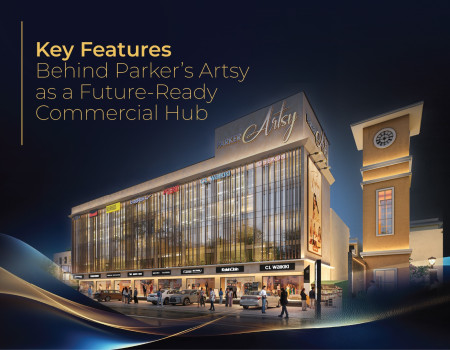
Commercial destinations that stay relevant share a simple trait: planning that matches how business actually runs, from storefront visibility to day-to-day operations. Parker Artsy presents a refined SCO address with a vertical format that supports retail on the ground floor and work-focused uses on upper levels, all under a single ownership pattern. Project fundamentals include a 160 sq yd plot, 35% covered area, a Basement plus Ground plus 1st to 4th floor configuration and a 15 ft frontage on a 45 MTR sector road, supported by two-sided entry, private lift, private staircase and a glass façade, alongside RERA approval and a possession timeline aligned to near-term planning.
A High-Visibility Address on a Wide Sector Road
Visibility remains a daily advantage for brands that rely on walk-ins, repeat visits and easy recall. A 15 ft frontage on a wide sector road creates a clear storefront line and a stronger chance of being noticed during peak traffic hours. A glass-led elevation strengthens street presence and supports premium signage, giving each floor a more distinctive commercial identity from the road-facing view.
SCO Planning that Separates Retail and Work Zones
The SCO format works best when customer movement and staff movement stay organised. Ground-level retail creates a natural fit for a commercial shop, while upper floors align with studios, clinics, consultancies, coaching centres, training institutes, professional services, compact co-working formats, salons, wellness spaces, cafés and bakeries. This stacked usability supports a mix of leasing approaches, including single-brand occupation across levels or floor-wise allocation for different uses.
Dual Access for Better Operational Control
Smooth operations depend on circulation that keeps peak hours manageable. Two-sided entry planning improves access management for mixed-use patterns, allowing separate movement routes for retail visitors and upper-floor users. A private lift and private staircase further strengthen operational control, improving convenience for staff, clients and deliveries across levels. In practical terms, controlled access supports better scheduling, clearer wayfinding and fewer bottlenecks during business hours.
Coverage that Leaves Room for Services and Functionality
A 35% covered area approach supports better internal circulation and service planning. Space for utilities, ventilation and back-of-house needs becomes easier to integrate when the site plan prioritises functionality alongside built-up area. That balance helps many business types operate efficiently, especially formats that require distinct zones for reception, consultation, storage and staff circulation.
Basement Utility that Supports Back-of-House Needs
Back-end capacity often decides how smoothly retail and service brands scale. Basement utility supports storage and operational functions that stay out of sight while remaining close to the point of service. Stock handling, record storage, staff facilities and equipment management fit more comfortably when an additional level is dedicated to support functions, keeping customer-facing areas cleaner and more focused.
Vertical Configuration Built for Flexible Leasing
A Basement plus Ground plus 1st to 4th floor layout enables multiple business formats within one asset. Vertical configuration supports mixed-use leasing and multi-tenant planning, giving flexibility to match evolving demand over time. A retail-ready ground floor supports strong walk-in visibility, while office-ready upper floors suit quieter, more focused work environments. Such zoning keeps business activity aligned with customer expectations, improving overall experience across levels.
Regulatory Clarity and Near-Term Delivery Focus
Regulatory assurance builds confidence during decision-making, especially for buyers comparing a commercial project in Kundli with other options in the region. RERA approval and development under applicable commercial norms provide a clearer framework for due diligence. Construction commencement and a possession timeline indicated within 8 months support planning for fit-outs, leasing conversations and phased business expansion.
Location Context for Growth in the Kundli Sonipat Belt
Kundli and the wider Sonipat belt continue to develop as a business corridor, driven by expanding residential clusters and demand for organised retail and services. A commercial property in Sonipat that pairs road visibility with vertical usability supports both local demand and regional footfall. Site positioning at Mantosh, Sector 63-64, reinforces a defined address that can serve as a dependable base for growing brands and professional services.
A Future-Ready Commercial Address, Built as a Single Asset
Future-ready commercial assets combine brand presence, operational clarity and flexibility in use. Those qualities shape long-term relevance for a commercial property in Kundli Sonipat, especially when mixed-use demand shifts over time. As a premium commercial space in Kundli, the format supports retail energy at street level and focused work environments above, while the vertical layout keeps multiple growth paths open. Development by the Parker Group anchors the offering in a structured, compliance-led approach designed for visibility and day-to-day performance.
COMMENT ON THIS ARTICLE
RECENT BLOGS